


There has been much talk about building resilience in the regions over the years. So much so, many of us have ironically become fatigued by it.
There are countless initiatives, social media campaigns, roundtable discussions and papers created to address the matter, but one thing I commonly hear from people in the room is: “What is this actually going to achieve?”
We’re living in a time where the fragility of our systems is becoming impossible to ignore.
What if resilience isn’t the goal?
Australia produces a huge amount of food and fibre, yet, as we have seen of late, local access, affordability, and distribution remain incredibly vulnerable. Worse still, farmers are left to absorb the shocks year-round, from weather, fuel, labour, inputs, supermarkets and consumer behaviour. Yet, we continue to centre conversations around regional people simply becoming more resilient.
This is a signal of a system begging to be redesigned. Regional people are not short on ideas, passion or lived experience. The problem is not that people in the regions lack resilience. The problem is that we keep asking them to be resilient inside systems not designed to holistically support vitality, while too often asking them to recreate wheels already turning.
Grounded clarity
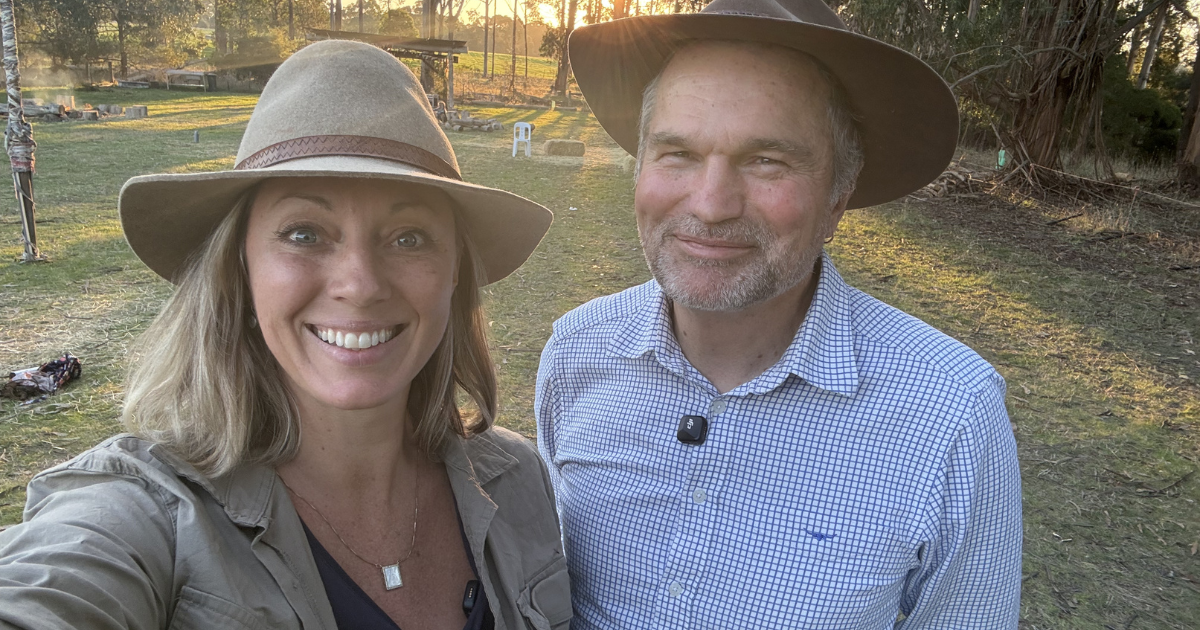
Recently, I attended the Grounded Festival at Yan Yan Gurt West Farm, a regenerative sheep and agroforestry property in the Otway Ranges, in Victoria.
The event brought together people from across the world and the nation: academics, scientists, wildlife advocates, farmers, medical doctors, and people deeply invested in the future of land, food, and communities.
What was beautiful to witness was the event's overall energy. There was no judgment or dogma. No criticism or anger. We were on even footing, eager to learn from each other and share from a place of knowledge and heart. These were people building resilience and health from the ground up!
This event was starkly different to a roundtable I had attended the week before in a major city. There was a similar dynamic in the sense that passionate people had been brought together in one room, but the energy was very different. There was a palpable gurgle of frustration. A sense that people were not entirely confident their time, thoughts and hearts would be genuinely heard by the people who’d invited them there.
And the reality is, many of us still show up despite this feeling, because we care. We show up because if we don’t, how can we complain that decisions are made without us?
But the contrast between those two events stayed with me. So, what was the difference? I think it came down to trust in the hosts, the quality of the questions asked, and the holistic view Grounded took of people, food, health, and the environment.
Health, prevention and repair
The reality is, a person cannot be truly well if their food system is broken, their community is disconnected, their work is unsustainable, and their landscape is under pressure.
At Grounded, there was discussion of models such as Recipe4Health in the United States, where food-based interventions are being integrated into healthcare. As well as receiving fruit and veggie boxes, patients also get support around behaviour change. I loved the idea of farmers as “farmacists”, and how the holistic model addressed prevention, treatment and reversal.
It’s a model that we should be looking at to build regional resilience and sustainability. Prevention by local capacity before a crisis hits, treatment by supporting people and systems already under stress and reversal by repairing the structural causes of fragility, not just managing the symptoms.
.png)
Embracing chaos
I deeply value nature, and I genuinely believe it holds the key to many of our woes. When we talk about resilience, many people focus on removing chaos or preparing for it. And yes, preparedness matters. But in nature, resilience is not created by removing every obstacle.
In a healthy river system, for example, chaos contributes to life. Rocks and bends create movement and oxygenate the water, making it healthier for aquatic life. Trees and roots stabilise banks, creating habitat for animals. Their waste adds organic matter, which feeds microbes and life further down the chain. There is a symbiotic relationship, and everything has a role.
Yet in many suggested solutions I have been observing of late, there is a tendency to remove the metaphorical rocks, roots and animals to create a tidier version of what a system “should” look like. It might be more comfortable to map, easier to fund or simpler to explain, but nature does not operate through a narrow lens.
Then there is the waste of resources. The constant overlap, disconnection and reinvention of models and systems that have already been created and are working well.
One of the clearest lessons from Grounded was that the first step in diagnosing farm health is looking at the soil- its colour, smell, structure, diversity, roots, rocks, groundcover and surrounding vegetation. You are trying to understand what is happening beneath the surface and what needs to shift to make the soil “rainfall ready”.
If you only look at the topsoil, you do not get the full picture. You may end up with a mono-solution. Fix that one thing. Increase this input year on year. But that is often a band-aid, not a pathway to long-term health.
The better approach is to look at the full system and the various elements that contribute to the overall health of that environment. The same is true of building resilience in the regions.
.png)
Nature is constantly trying to repair itself through homeostasis so why are we not taking its lead? Simply put, we’re not creating the conditions that allow repair to happen.
Those conditions are not only technical. They are relational, emotional, economic and cultural. It is trust, safety, time, local leadership, knowledge-sharing, systems-thinking and coordination. It is also nourishment, rest, joy, strategic collaboration and a calm nervous system.
Trust is now one of our most valuable currencies and one of the most depleted. This is where local communities and localisation become more than a nice idea. It becomes a resilience strategy.
It means building more holist
ic, and interconnected capacity. It means shorter supply chains, stronger local procurement, food hubs, farmers’ markets, community-owned infrastructure, school food literacy, farmer-owned shops, regional storytelling, natural capital thinking and local health partnerships. It means ensuring our regions are not completely at the mercy of decisions, disruptions, and price shocks.
A healthy regional system recognises that there’s already meaningful work happening and it supports it. It doesn’t try to build everything from scratch but amplifies what already has life.
And if I’m honest, it’s one of the core reasons why I created Vitality Farms Northern Rivers. It is not the movement itself; but it exists to help the movement see itself.
The call to build vitality
The future of regional resilience will not be built by one organisation, one grant, one policy or one charismatic leader.
It will be built like healthy soil: layer by layer, season by season, through structure, diversity, organic matter, patience and care.
It will be oxygenated by honest conversations, strengthened by trust, nourished by local food and held together by stories that remind us what is possible.
They are one living system. And if we want healthier regions, we need to design, communicate and collaborate like living systems full of vitality do.
That is true resilience.
If you would like to learn more about our Vitality Farms Northern Rivers project, head to our website or follow us on social media @vitalityfarmsnorthernrivers

